TING: The Chinese Word That Teaches Six Channels of Real Listening
When someone says you weren't listening… they almost never mean your ears didn't work.
They mean something else dropped.
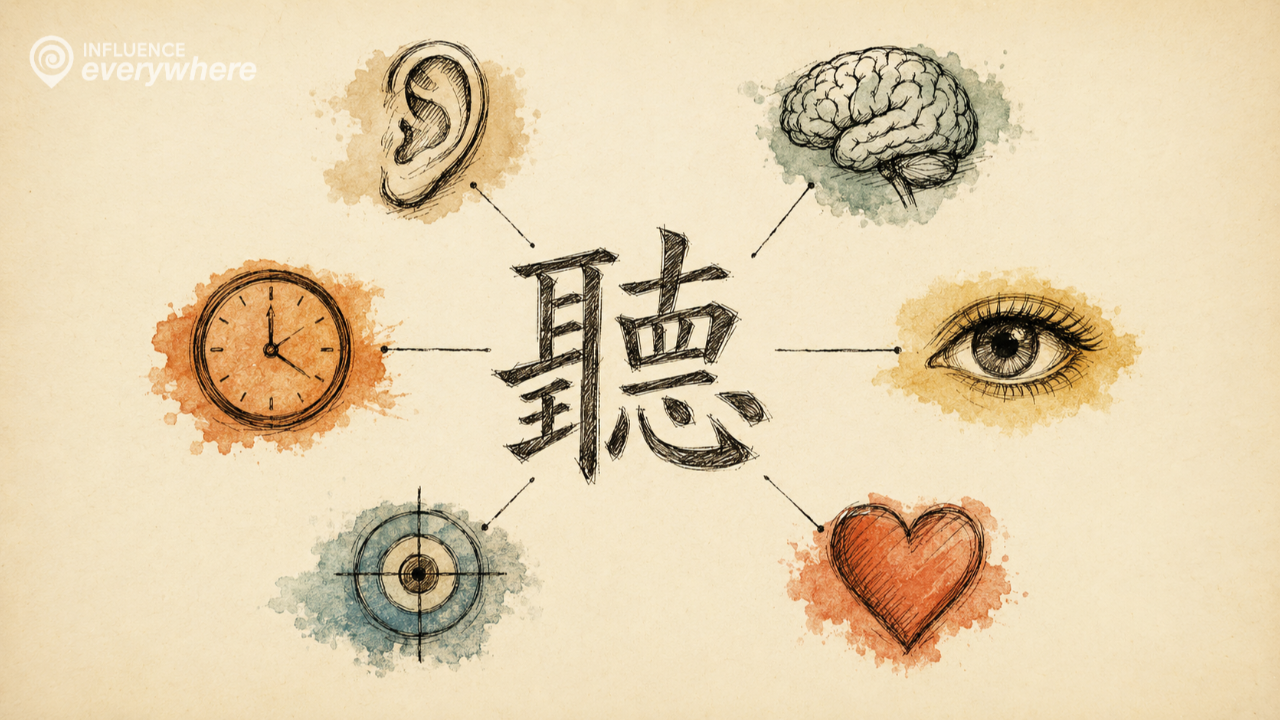
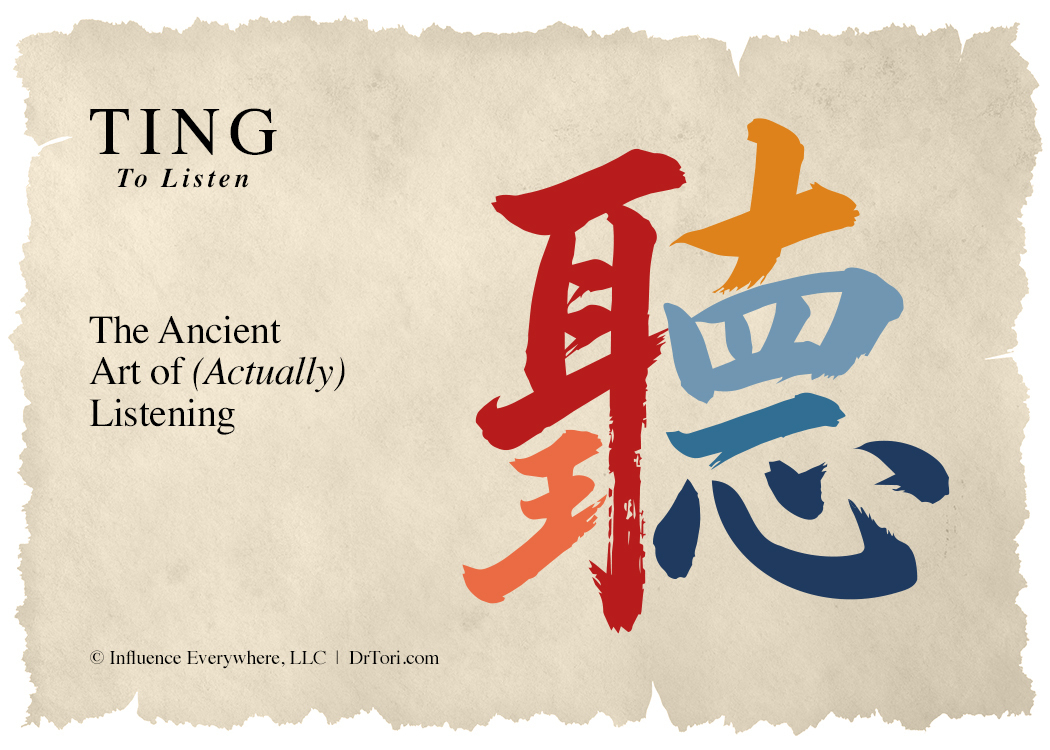
There's a Chinese word that maps it. The word is ting (聽). It means to listen. And like many Chinese characters, it's built from smaller pictographs stacked into one symbol. Each component is a different dimension of what real listening actually is.
There are six of them.
The Six Channels of TING
1. To hear. Not just the words. The tone. The cadence. The grunts and sighs that carry as much meaning as the sentences. The change in someone's voice when a topic shifts.
2. To think. This is where most of us drop the ball. We hear the words and immediately begin shaping our reply. The "to think" channel is the one that pauses and processes what was actually said... what it means, what it costs them, what it asks of us.
3. To be present. In the moment. With this person. Right now. Not five minutes ahead in the meeting agenda. Not back in the argument from last week. Here.
4. To see. A huge percentage of communication is visual. Micro-expressions. Body language. The angle of the shoulders. The flicker in someone's face right before they say the thing they almost couldn't say. The "to see" channel notices.
5. To focus. When the mind drifts (and it will), focus is the channel that brings it back. One practical move: pick something the other person just said and try to picture it. Step inside their image. Hold it.
6. To feel. Theirs. And yours. Empathy is the obvious half. The less-obvious half is noticing when your own emotional state shifts mid-conversation. That shift is often the highest-yield invitation in the room — to go deeper, to ask a different question, to slow down.
Why TING Matters
Most "communication problems" are TING problems.
Two people both feel unheard. Both are nodding. Both are even responding to the words. But one or more of the six channels are offline on both sides.
The frame is useful because it gives you something to audit. When a conversation goes sideways, you can ask: which channel just fell short? And bring it back.
It's also useful as a leadership lens. Most leaders who feel "not heard" by their teams… are not running the full six themselves. The team feels it before anyone can name it.
Watch for the Change
If there's one move that lives at the center of TING, it's this:
Watch for the change.
A change in their voice. A change in their breath. A change in the angle of their shoulders. A change in the rate at which they're speaking. A change in the tightness around their eyes.
The change is almost always the moment that matters.
Most people miss it. They're hearing the surface content and preparing their reply.
The ones who notice the change are the ones the room listens to.
A Practice for This Week
You don't have to remember all six channels in the moment. That's too much.
You just have to remember to audit after a conversation that mattered.
Run the check: Did I hear them? Think about what they said? Stay present? See them? Stay focused? Feel anything?
If the answer to any of those is no, that's the one to bring forward next time.
That's the work.
Get Your Listening Score - Take Dr. Tori's TING Assessment
The TING framework is one of the foundations of how I teach influence and communication. I learned it from one of my hypnotherapy teachers, the late Ron Klein, in 2002. I've used it in almost every keynote, every workshop, and every difficult conversation since.
If you want the full framework and a worksheet you can carry with you, it's at DrTori.com/ting.
STOP reacting! Be Deliberate Instead...
If you’re busy and you want to have incredible success in your career and at home, then take a page out of your Influence Playbook. No more winging it. No more just going through the motions. And no more trying to control things (or people) you can't control.
Instead, control the controllables with The Influence Playbook:
What's Your Listening Score?
How well do you listen?... like actually listen? This one word will change every interaction you have from now on. See where you stand...

Get Your Conversation Score
How well do you navigate conversations? Struggle with small talk? Fumble the greeting? Find out...

What Are Hypnotic Gifts?
You can transform someone's life in a single conversation. In his new book, Dr. Tori gives you the map.
