Why You Can Pitch To A Zombie Better Than To Your Own Team
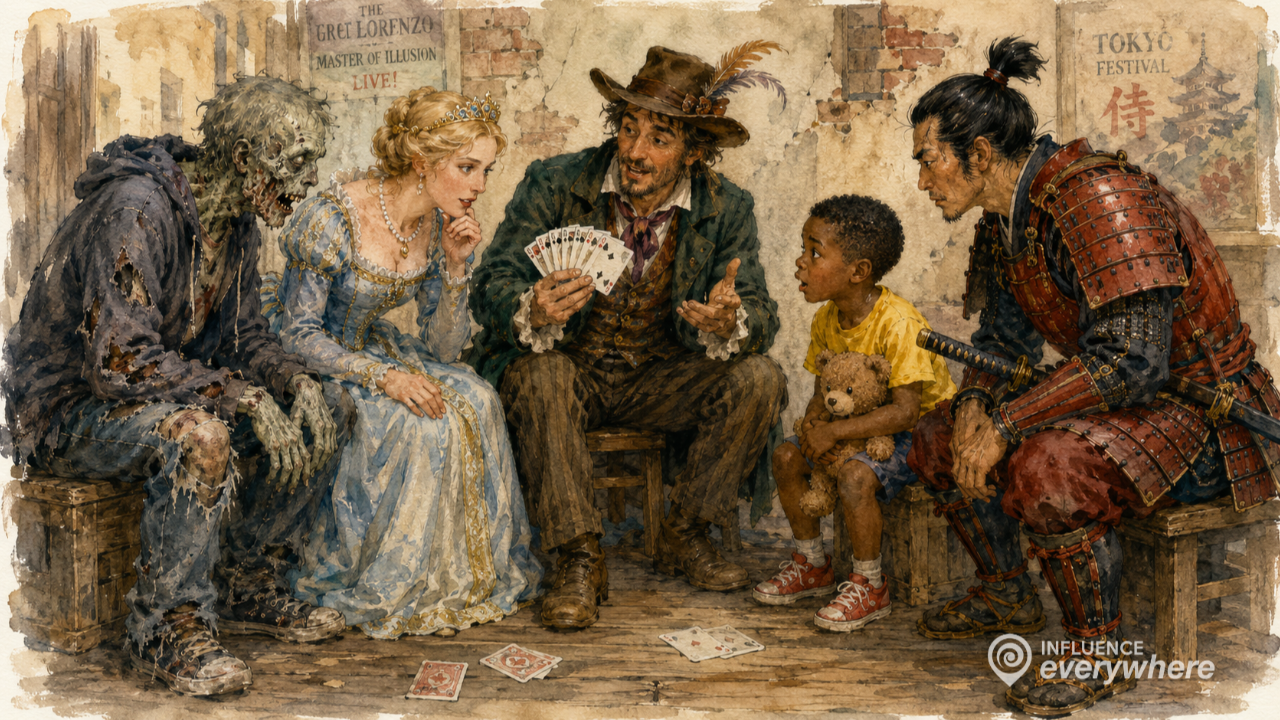
There's a board game called Snake Oil.
You get a hand of cards with random nouns on them. Friend. Blanket. Hammer. Telescope. Pillow. Mirror.
Each round, one person becomes the buyer — they get a character card. A diva. A zombie. A kindergartner. A pregnant woman. A ninja. A samurai.
Everyone else combines two of their nouns into a product and pitches it to the buyer. The best pitch wins.
My kids won't play it with me anymore. They said it wasn't fair. I do this for a living.
So I made a deal: I'd teach them one persuasion pattern before each round, then we'd play. Then I'd teach another. Then we'd play again.
That's how the Snake Oil workshop was born.
I now run it for organizations. Hospitals, law firms, leadership cohorts, risk management teams. It is one of the funniest two hours I get to spend in my work. But the laughter is not the point.
The point is this.
The First Round Is Already Astonishing
The first time I ran Snake Oil with adults - before I taught them a single thing - their pitches were already remarkable.
These are people with day-job voices. A physician walks into a patient room and says "We need to discuss your cardiovascular risk reduction strategy." A leader walks into a meeting and says "Let's analyze the metrics in each vertical." A lawyer walks into a deposition with a vocabulary built over a decade of practice.
Hand the same people a card that says "diva" and a card that says "blanket" — and they become a completely different version of themselves.
They tailor. They connect. They walk the diva into a future where the friend-blanket washes away the fake people in her life and lets her sleep next to something that loves her.
They find commonality with a fictional zombie.
They speak the language of a kindergartner.
And they have no idea they're doing it.
The Contrast Is the Lesson
When I point it out, the room goes quiet for a moment. Then someone laughs. Then they all look at each other and the laughter spreads... because they've all just had the same realization at the same time.
They can pitch a zombie better than they can pitch their own frontline staff.
The skill they think they're missing, they already have it. They use it in games. They use it with their kids. They use it when they're trying to convince a friend to try the restaurant they like.
The skill never went away. The frame turned it off.
When we put on the professional uniform, we trade the skill we already have for the script we think we're supposed to use. We talk at people instead of to them. We deliver information instead of moving someone toward a future. We default to jargon. We forget that the diabetic patient in front of us is a teacher, a single mom, exhausted, worried about her son - and we tell her about her cardiovascular risk reduction strategy.
She nods. She doesn't hear a word.
This connects directly to Rule 4 of the 7 Simple Rules: move people with what already moves them. The information you have is rarely the thing that moves them. The thing that already moves them is the thing that already moves them. Your job is to find it first, then connect what you know to what they care about.
Creativity Within Constraints
There's a second thing I notice every time.
People walk in saying "I'm not creative."
Then they pick up the cards.
Five minutes later they're explaining why a Hammer-Telescope is exactly what a samurai needs to spot threats from afar and still settle them up close. And they're not just creative... they're competitively creative. They're trying to out-pitch the person next to them.
Constraints did this. Not freedom. Not open space. Seven random nouns and a buyer.
Creativity fires inside walls. The walls are the prompt.
What to Try This Week
Before your next high-stakes conversation (a meeting, a difficult talk, a client call, a hard moment with someone you love) try this.
Picture the person on the other side of the table as the buyer in a card game.
What language do they actually live in?
What future are they trying to get to?
What already moves them?
Pitch them that.
You already know how to do this. You did it last weekend with the people you love, over dinner, without thinking about it.
The frame just has to come with you when you walk into the room on Monday.
The full episode on Snake Oil is on the Influence Every Day Show, Episode 020. If you want to bring the Snake Oil workshop to your team, schedule a discovery call at DrTori.com/speaker. And if you want to get the actual game, here's an affiliate link: Snake Oil Game.
STOP reacting! Be Deliberate Instead...
If you’re busy and you want to have incredible success in your career and at home, then take a page out of your Influence Playbook. No more winging it. No more just going through the motions. And no more trying to control things (or people) you can't control.
Instead, control the controllables with The Influence Playbook:
What's Your Listening Score?
How well do you listen?... like actually listen? This one word will change every interaction you have from now on. See where you stand...

Get Your Conversation Score
How well do you navigate conversations? Struggle with small talk? Fumble the greeting? Find out...

What Are Hypnotic Gifts?
You can transform someone's life in a single conversation. In his new book, Dr. Tori gives you the map.
